Last year, we shared Mom L's story.
A Secret Weapon for Calming an Autistic Child's Emotions: A Mother's Real Account
At the follow-up this September, she brought good news: her older child has smoothly entered first grade at a mainstream primary school, and for now needs neither an accompanying parent nor a shadow teacher.
What exactly has changed for the child over this past year or so? We thank Mom L for letting us keep following up and for sharing her child's progress over this period.
Key points from one and a half years on Chienomoto
| Time | Use and growth record |
|---|---|
| The child's background | November 2022 (age 3), developmental quotient (DQ) assessment: 55: January 2024, Wechsler Preschool (WPPSI): 72; October 2024, entered a special-needs kindergarten; big mood swings; poor attention, hyperactivity, cognitive and language delays; average motor coordination; attending language classes and receiving interventions such as transcranial magnetic stimulation. |
| February 2025 | Started Chienomoto No. 2. |
| March–April 2025 | Mood became steadier; no other changes observed yet. |
| June 2025 | Both sleep and mood had steadied; his mother said she would keep him on it to consolidate things for the brain. |
| September 2025 | Moved to the top class of a mainstream kindergarten, receiving inclusive education; Wechsler (WPPSI) assessment: 82 |
| February 2026 | Improved sleep, steady mood; improved cognition. |
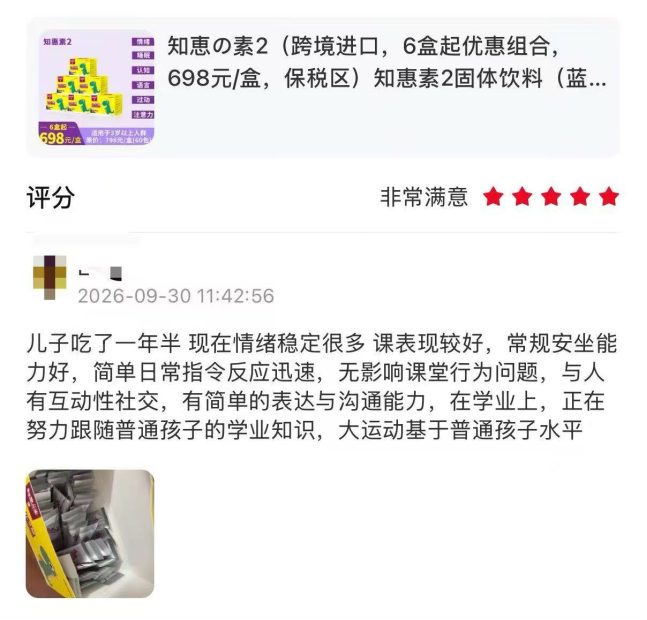
| August–September 2026 | Feedback from teachers at the center: follows classroom routines, with good ability to sit properly as required; no behavior problems that disrupt class; responds quickly to simple everyday instructions; engages in interactive social exchange with others, with simple expression and communication skills; clear progress in gross motor skills; |
| September–October 2026 | Smoothly entered first grade at a mainstream primary school; steadier mood; able to live, learn, play and express his own needs like an ordinary child; gradually adapting to primary school life; still working hard to keep up academically. |
Slowly learning to accept failure and losing
At the first follow-up in March 2025, the child was 5 and a half and attending a special-needs kindergarten, with poor attention, hyperactivity, cognitive and language delays, and average motor coordination. At the time he was also attending language classes and receiving interventions such as transcranial magnetic stimulation.
At the follow-up in September 2026, his mother said that in the past, even a normal remark in an ordinary conversation might be more than he could take, and he would feel people were talking about him. Now he is gradually able to accept failure and accept losing. In the past he learned pinyin and math very slowly; now his comprehension has improved too, and she feels he understands a bit more of everything.
The changes in his mother's eyes
When asked what the biggest change over this past year or so had been, Mom L sent the following passage, which is very encouraging: steady mood; living, learning, playing and expressing his own needs like an ordinary child; clear progress in gross motor ability; gradually adapting to primary school life; fitting into the group and into society better.

Feedback from teachers at the center
Before he started school, Mom L had already spoken with the school about her child's situation. She said that for now he needs neither an accompanying parent nor a shadow teacher, and that no complaints have come from his teachers so far. In both academics and sports, he is working hard to keep pace with ordinary children.
His mother also relayed the center teachers' assessment of his classroom performance: he follows classroom routines, responds quickly to simple instructions, can interact with others, and has simple expression and communication skills.
Rehabilitation training has continued all along
During this time, the child has still been doing cognitive, sensory integration, and preschool-to-primary transition rehabilitation training. His mother confirmed that no other medication has been used and that the intervention plan has not changed significantly over the past year.
In closing

Behind his mother's simple exclamation lie countless efforts by the child and his family.
From steadier mood to gradually adapting to primary school, the child still has areas where he needs support. The use of Chienomoto No. 2 is one part of this journey of growth. We will keep following his learning and life going forward.
This article is compiled with the parent's authorization from follow-ups, chats and reviews. The content consists of individual observations; growth, rehabilitation training, and family and school support may all influence the changes, so the role of any single product cannot be judged from it, and it does not mean other children will have the same changes.