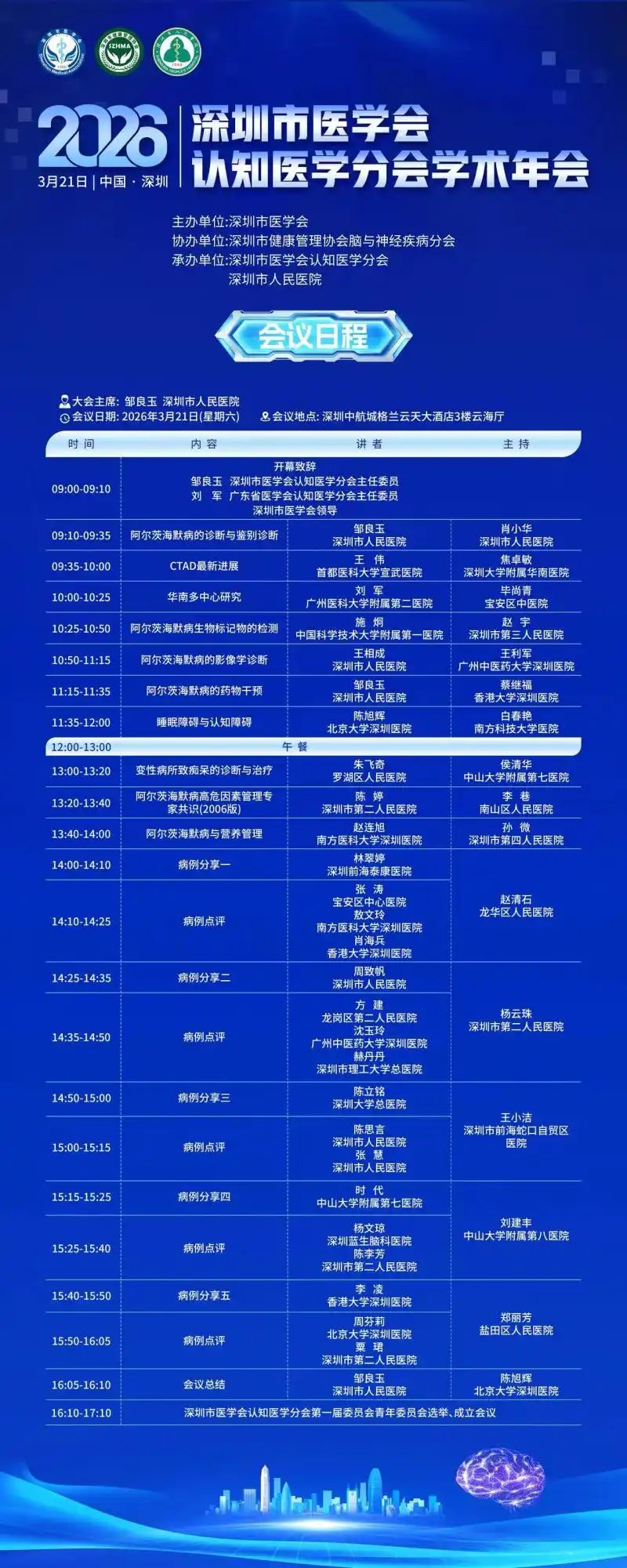
On March 21, 2026, the Shenzhen Medical Association's 2026 Annual Academic Conference of the Cognitive Medicine Branch was held at the Shenzhen CACC Grand Skylight Hotel. The conference focused on exchanges around the diagnostic and treatment frontiers, research progress, and clinical management of cognitive medicine and age-related degenerative diseases such as Alzheimer's disease, and was attended by experts, scholars, clinicians, and representatives from related enterprises across numerous medical institutions in the province. Guangzhou Zhihui Biotechnology Co., Ltd. was invited to attend the conference and exchanged views with clinical experts on nutritional management approaches related to cognitive impairment.
According to the introduction, the conference agenda included academic presentations, case sharing and commentary, committee-related meetings, and other segments. Multiple experts shared insights on topics such as the diagnosis of Alzheimer's disease, biomarkers, imaging assessment, progress in pharmaceutical treatment, as well as sleep disorders and cognitive impairment, reflecting how the current approach to managing cognitive impairment is gradually shifting from a single-treatment perspective toward a comprehensive management model that combines medication, nutrition, rehabilitation, and long-term care.
During the afternoon case-sharing and thematic discussion session, Dr. Zhao Lianxu, Director at Shenzhen Hospital of Southern Medical University, gave a presentation titled "Alzheimer's Disease and Nutritional Management," sharing approaches to nutritional support for people with cognitive impairment and related application observations drawn from clinical practice. Dr. Zhao noted that the management of cognitive impairment, particularly Alzheimer's disease, focuses not only on core cognitive symptoms but is also increasingly attentive to comprehensive issues such as sleep, mood, behavioral presentation, daily functioning, and caregiver burden — meaning the value of nutritional management is reflected more in overall support and long-term collaborative management.
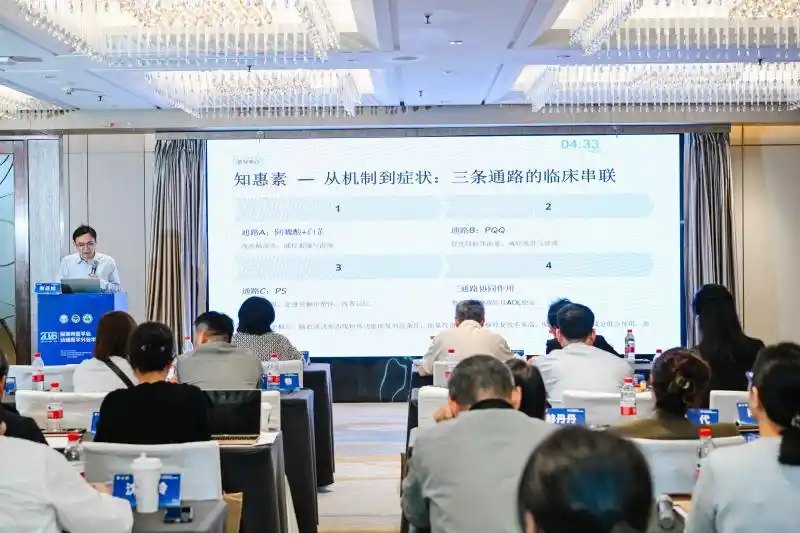
As one of the topics discussed at the conference, the combination of ferulic acid and plant extracts found in Chienomoto has drawn some attention in cognitive-impairment-related research in recent years. Existing research suggests that these ingredients may support brain health through multiple pathways, including reducing neuroinflammation and oxidative stress, improving the neuronal microenvironment, supporting synaptic plasticity and neural network stability, and maintaining cerebral energy metabolism. It should be noted that the above mechanisms are drawn primarily from basic research and some translational research, and their clinical significance still requires further validation through more high-quality studies.
At the clinical research level, a multi-center, randomized, double-blind, placebo-controlled prospective study conducted in Japan enrolled people with mild cognitive impairment. Results showed that the intervention containing ferulic acid and Angelica extract achieved better MMSE scores than the control group at 24 weeks, and also showed statistically significant differences in ADAS-Jcog scores at both 24 and 48 weeks — suggesting it may offer some cognitive support value during the mild cognitive decline stage.
Another prospective open-label study on behavioral and psychological symptoms associated with frontotemporal lobar degeneration and dementia with Lewy bodies found that, after a 4-week intervention, total Neuropsychiatric Inventory scores decreased, with improvements also seen in sub-scores for hallucinations, delusions, agitation/aggression, anxiety, apathy, and irritability, and no notable adverse effects were reported in the study. The researchers believe this direction warrants further exploration in the management of dementia-related behavioral and psychological symptoms. However, the sample sizes in these studies remain small and the evidence level limited, making it more accurate to describe them as "providing a basis for clinical observation" rather than as confirmatory conclusions.
It is worth noting that not all study results show consistent benefit. For example, in another open-label study of people with mild cognitive impairment, the 48-week intervention did not show a clear inhibitory effect on cortical amyloid deposition, progression of brain atrophy, or cognitive decline. This also suggests that nutritional interventions related to cognitive impairment still require continued evidence-building regarding suitable populations, observation endpoints, and long-term effects.
Industry observers believe that as approaches to managing cognitive impairment continue to evolve, nutritional support is gradually shifting from being viewed as a traditional "supplementary aid" toward becoming part of comprehensive management. For clinical practice, the more valuable direction is not to simply emphasize a particular ingredient, but to focus on whether it can provide practical support for cognitive function, behavioral symptoms, sleep state, care cooperation, and quality of life.
Guangzhou Zhihui Biotechnology Co., Ltd. stated that it will continue to follow developments at the intersection of cognitive medicine and nutritional management, and, in line with clinical needs and research progress, will promote academic exchange and application exploration for related products on a standardized and prudent basis, to provide additional support approaches for the comprehensive management of people with cognitive impairment.
Disclaimer: The content of this article is corporate information reposted by this website and represents only the author's personal views; it is not related to this website. The content herein does not constitute investment or consumer advice, is provided for readers' reference only, and readers should verify the relevant content independently.
Original article reposted from: Xinhua Daily Press Group (Xinhua Baoye Wang)
Want to know whether Chienomoto is right for your family's situation?
Free Consultation with Customer Service